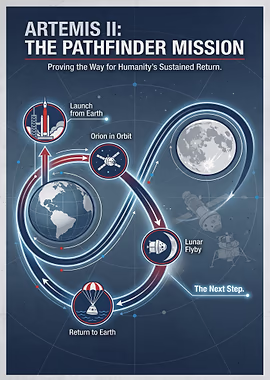
A Design Tradition Baked Into the Program
Since the earliest crewed missions, NASA has treated mission identity as seriously as mission engineering — mission patches designed with the crew, and promotional art meant to make an abstract trajectory or an orbital plan legible to the public. It's a tradition that stretches back to Mercury and Gemini and continues, largely unbroken, through Artemis.
Making an Orbit Legible
Artemis II, planned as a crewed lunar flyby mission, involves a trajectory that's genuinely difficult to explain in words: a path around the Moon and back, shaped by orbital mechanics rather than a straight line. Mission path graphics solve that problem the way a subway map solves a city — not literal, but instantly readable, trading strict accuracy for clarity.
Why This Style Suits a Poster
Space agency graphics tend toward bold geometric shapes, high-contrast palettes, and confident typography, for the same reason mid-century travel posters did: the goal is awe and clarity, not documentation. That makes mission art some of the most naturally poster-ready design NASA produces.