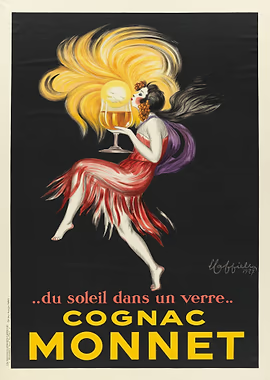
The Problem Cappiello Solved
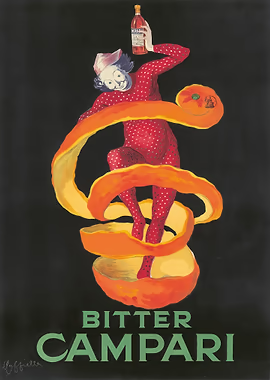
At the turn of the 20th century, advertising posters in Paris were crowded, text-heavy affairs — dense compositions trying to cram every product detail into a single sheet. Leonetto Cappiello, an Italian illustrator who settled in France in 1898, took the opposite approach. He stripped a brand down to one vivid figure, floating against a flat, saturated background, with just enough text to name the product.
It sounds simple now because it became the template for a century of advertising that followed. At the time, it was radical.
A Dancer for Cognac Monnet
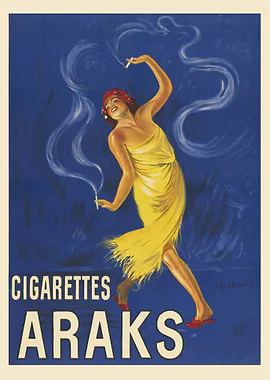
The piece featured here is one of Cappiello's spirits campaigns: a dancer rendered in his signature style — dynamic pose, theatrical gesture, and a palette built around two or three dominant colors that make the image legible from across a street. This wasn't incidental. Cappiello had trained as a caricaturist before moving into advertising, and that background shows in how economically he could suggest movement and personality with a few confident lines.
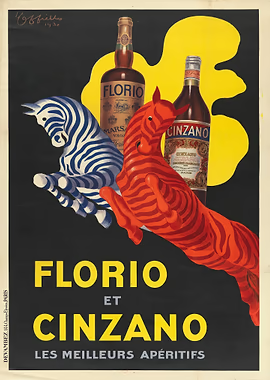
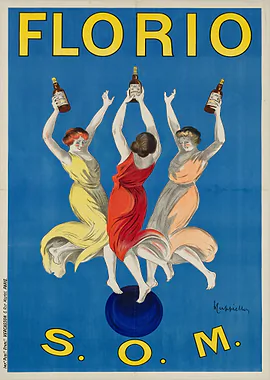
Spirits and aperitif brands were some of his most frequent clients, precisely because the category needed exactly what he offered: an image people would remember faster than they could read a slogan.
Why It Still Reads as "Art Deco" Today
Cappiello's career (roughly 1900 through the 1930s) overlapped with the rise of Art Deco, and his flattened forms, bold outlines, and graphic confidence share a visual language with the movement even where his work predates its formal definition. That's part of why these posters have aged so well as wall art: they were built to work as pure image first, information second — which is exactly what makes a piece hold up on a wall a hundred years later.